
Three Insights from a Week of Conversations in China on Foresight, Future Generations and Intergenerational Fairness
Exchanges across universities, policy schools, technology strategists and old friends, left me reflecting on where China is heading on foresight, long-term thinking, and the future of its young people

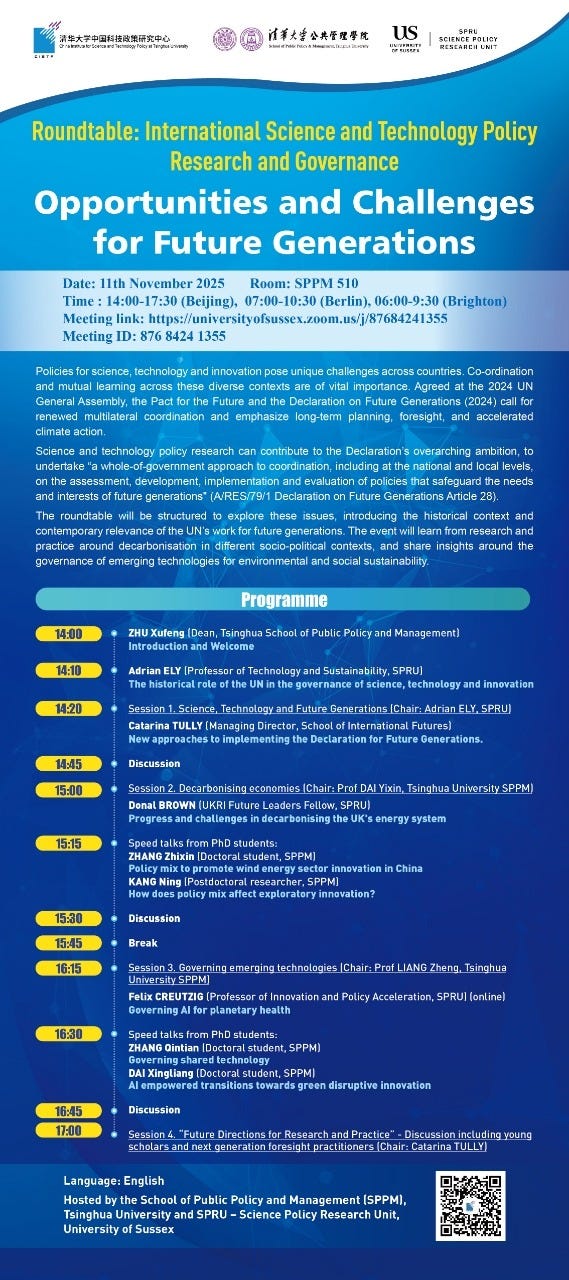
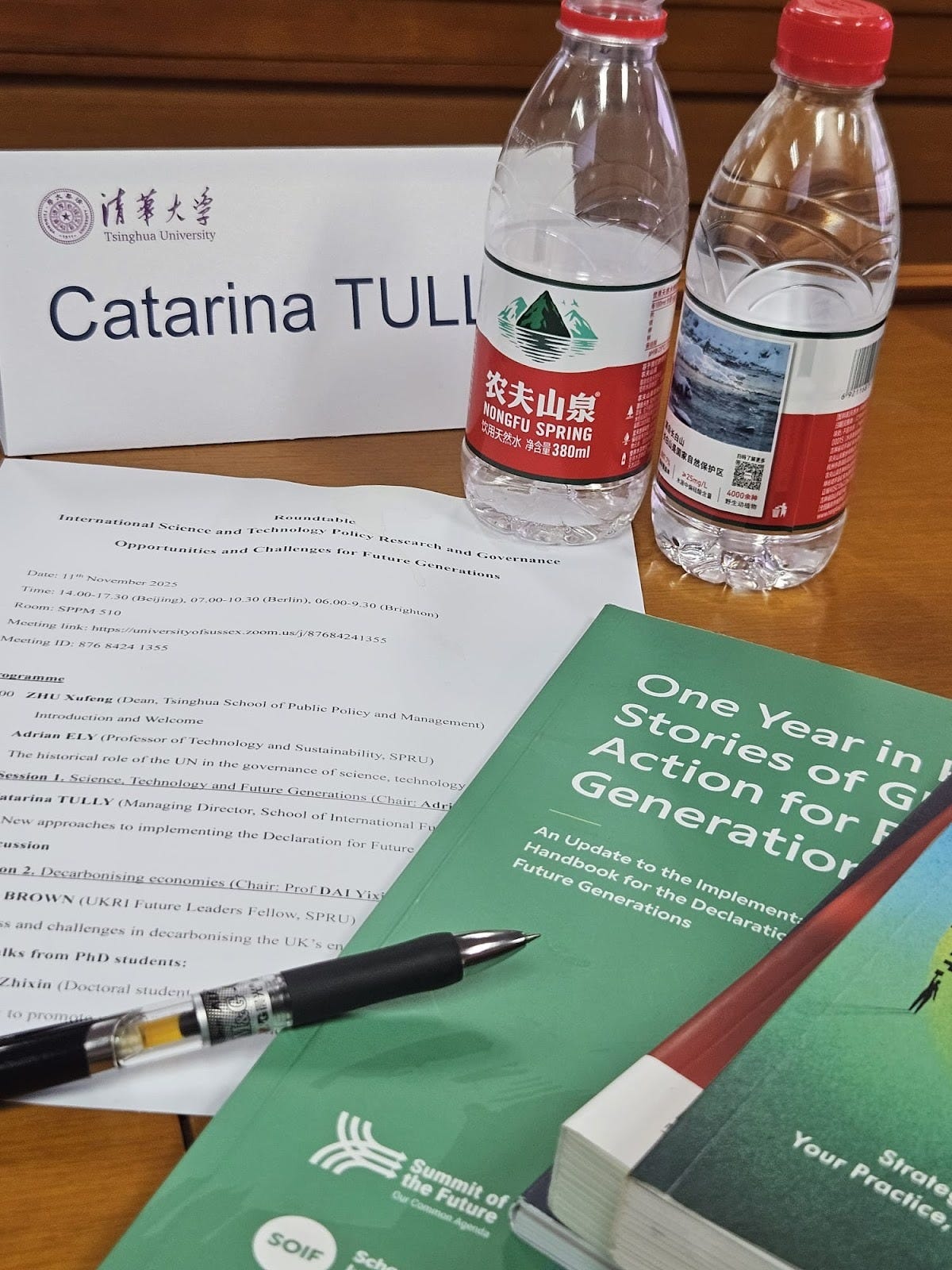
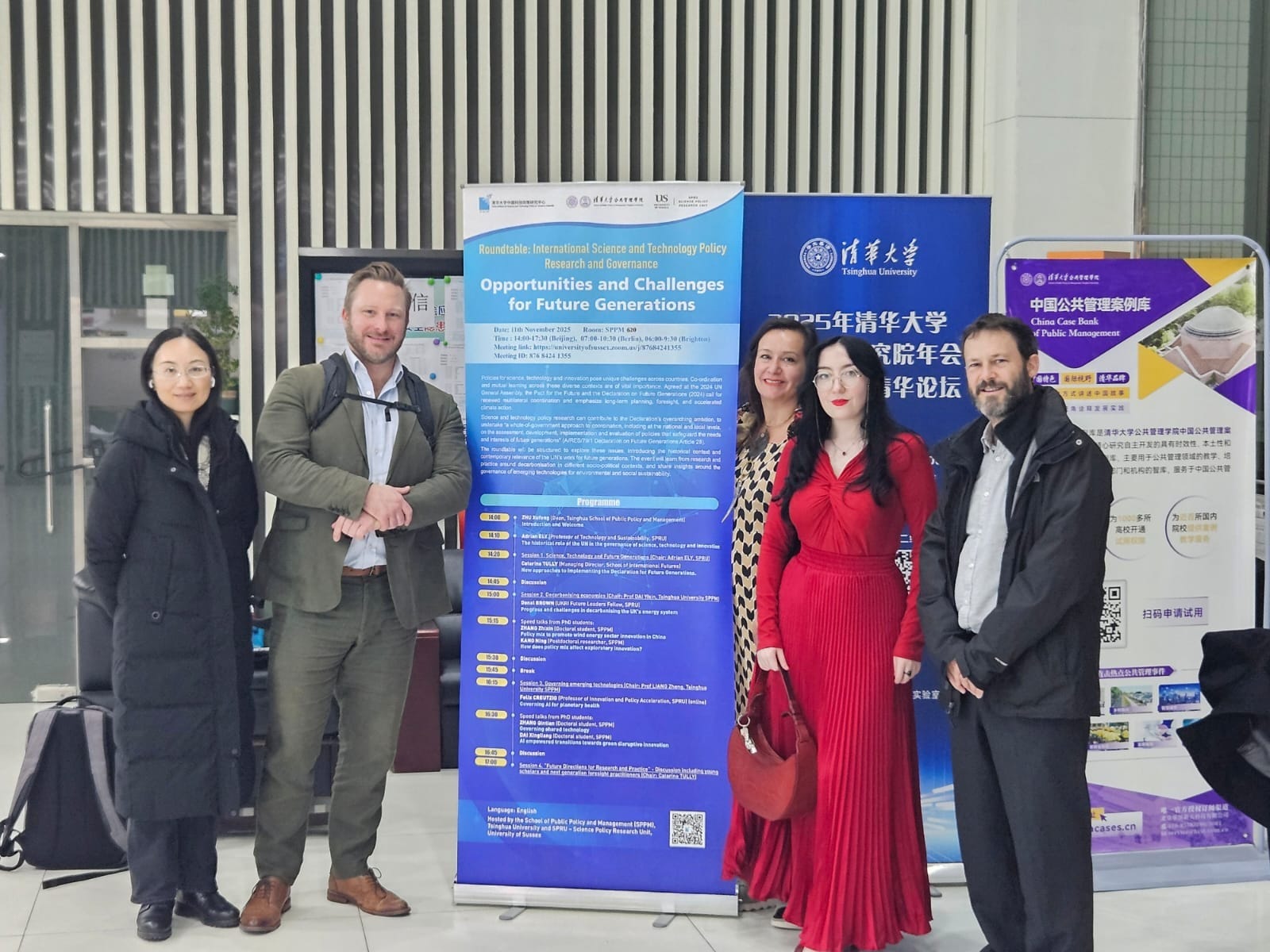
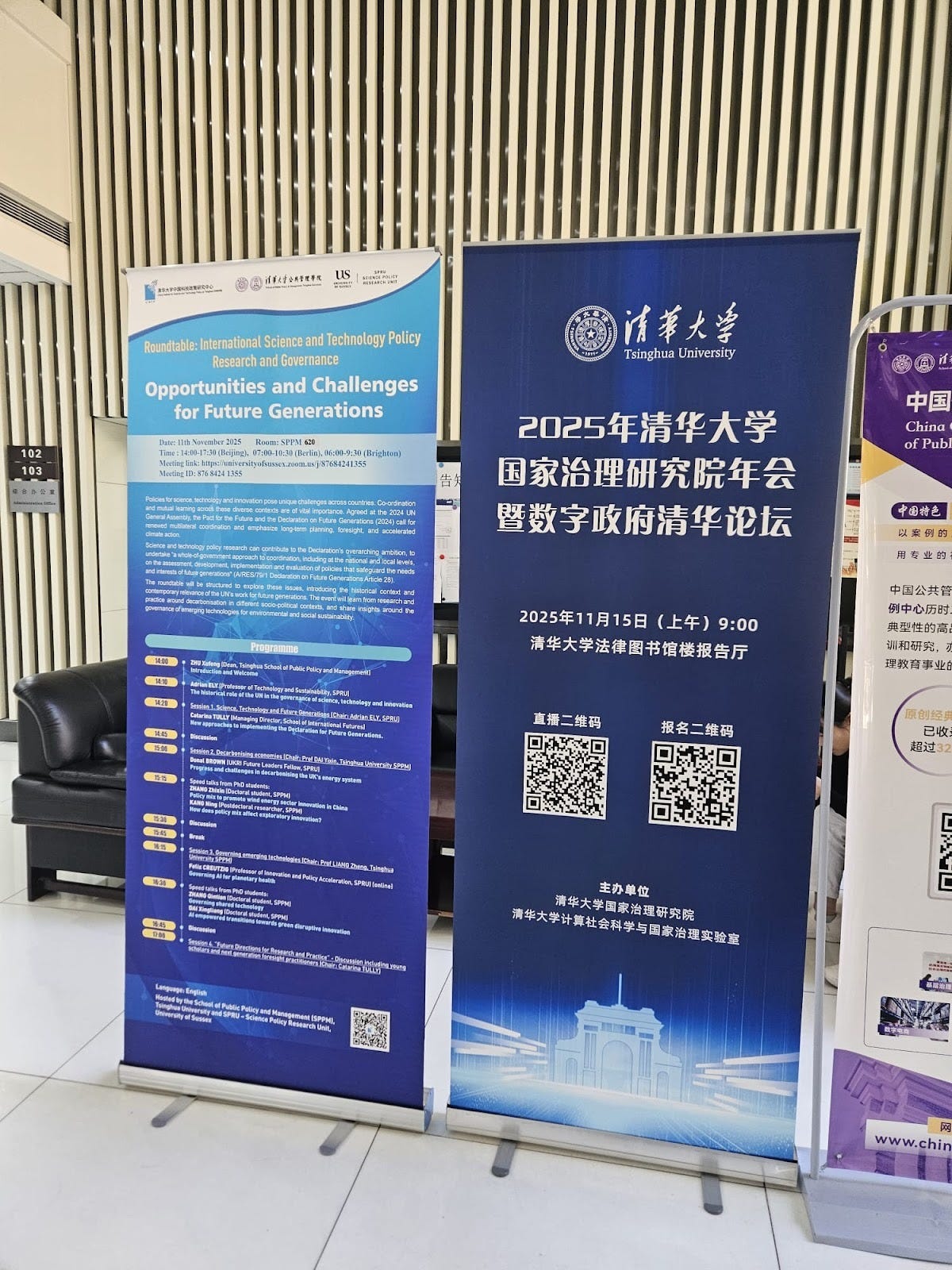
I’ve just come back from a short but very full week in Beijing, where I met curriculum innovators and scholars working on governance and technology, spoke with strategists in the private sector, and compared notes with old friends. It included a fascinating Tsinghua University Roundtable on Future Generations (see the agenda below), jointly held with their long-standing partner, the Science Policy Research Unit at the UK University of Sussex.
I was struck by the emerging interest in China around the intersection of foresight, anticipation, technology adoption and long-term governance — and how similar many of the intergenerational issues are to those we see everywhere else.
Three observations stayed with me.
1. A growing interest in foresight — even in a country already known for long-term planning
One of the most striking things I heard this week was how often people said, unprompted, that they’ve been “hearing the term foresight everywhere” recently. This is in a system often held up by the West - rightly so in terms of harnessing the economic and developmental potential of technology - as an exemplar of long-termism, with its five year national plans, technology roadmaps and strong state investment in a longer-term horizon.
The message I heard was that traditional long-term planning tools aren’t enough anymore. Delphi, which has been central to China’s approach to technology forecasting, was described as too present-biased and too linear for the level of uncertainty ahead. People talked about needing scenarios, alternative pathways, horizon scanning, and tools that can help decision-makers hold multiple realities at once.
Several used the example of driverless cars: China could adopt rapidly, but more than ten million workers depend on platform taxi apps, and even more on food delivery services. Questions about the pace of technology adoption are becoming questions about intergenerational fairness and systemic governance, not simply efficiency or innovation.
The appetite for foresight capability — especially to explore trade-offs, social impacts and alternative futures — is clearly growing.
2. A real questioning of obligatory targets — and a focus on anticipatory ones
The second theme — and one that runs counter to many of our clichés about China — is that targets themselves are increasingly seen as distorting. Several people were explicit that obligatory targets, in particular, are unhelpful. They narrow attention, create perverse incentives, and push systems towards hitting numbers rather than understanding what is actually changing.
Instead, what people described as far more powerful were anticipatory targets — goals that adapt as conditions evolve and that help decision-makers navigate uncertainty rather than lock them into rigid pathways. This also means fewer numbers than you would expect, including in areas like municipal five-year plans, where the shift away from numerical thresholds is already becoming visible. It was striking to hear this so clearly articulated in a context known for technocratic planning - something we can learn from. There’s a great academic paper from the School of Policy and Public Management that explores some of this - here’s a quote from the abstract:
Specifically, this study adopts natural language processing (NLP) methods to extract two distinct RSTP policy goals—anticipatory and obligatory—and investigates the heterogeneous effects resulting from these goals. The results show that RSTP positively impacts local GGTs’ development but has negative geographical spillovers on neighbouring cities. Additionally, RSTP’s anticipatory goals positively influence both GGTs and innovation-network spillovers. In contrast, its obligatory goals yield adverse effects, likely due to policy myopia, their coercive nature, and limited flexibility in fostering dynamic interactions and coordination. [From Regional S&T planning and green generic technologies: A spatial differences-in-difference analysis by Yuan Zhou, Qintian Zhang, Guannan Xu, Yanmeng Wang (Energy Economics 150 (2025) 108815).]
3. China’s intergenerational fairness challenges look far more like those of other ageing societies than we often assume
The third, and perhaps most important as well as personally surprising, observation is that China’s comparatively successful long-term planning does not exempt it from the same IGF pressures we see globally in ageing societies.
Remarkably familiar dynamics on housing, pensions, taxes. People raised:
housing costs that lock younger generations out of opportunities, including the move of young people to cheaper second-tier cities;
asset and pension arrangements that favour older cohorts;
anxieties about whether pensions will exist for today’s young adults;
tax and benefit structures that feel inequitable across generations.
Two nuances stood out:
First, the rural–urban pension divide is enormous and creates both intra- and intergenerational impacts. Children in rural settings shoulder the gaps of their parents’ later-life insecurity, and this shapes the futures of the next generation too.
Second, the “lying flat” movement — where young people quietly opt out of competition and ambition — is a very different kind of pressure release valve from what we see in democracies, where IGF frustration often fuels far-right, anti-system or anti-establishment politics. The emotional drivers, however, are strikingly similar.
My key takeaway: Long-term planning does not immunise a society from intergenerational fairness challenges; the dynamics are global
Closing reflections: a global field building moment
China is a country with deep, institutionalised capacities for long-term thinking. But even here, a new set of questions is emerging.
Foresight is no longer a niche or foreign concept; it is becoming necessary to navigate the scale and speed of change. There is a clear appetite for adaptive, anticipatory approaches beyond rigid targets. And the intergenerational challenges facing young people — from housing to pensions to the psychological pressure of an uncertain future — look far more similar to those in ageing democracies than many assume.
This week in Beijing left me with a very strong sense of urgency — not just about the substance of these issues, but about the need to build a global and collective governance, research and scholarly agenda around them.

In a world edging toward geopolitically driven technology decoupling of the West from China and growing distrust, we cannot afford to explore long-term governance in isolated national silos. The questions are universal, and the intergenerational risks of divergence — in AI, biotech, data regimes and institutional design — are huge.
One concrete next step would be to create genuine academic incentives for people to work on these questions. That means:
a conference that brings together leading universities and scholars working on future generations, foresight, long-term governance and anticipatory practice;
a special journal edition to give academic recognition and legitimacy to work in this young, transdisciplinary, often under-resourced field;
and a shared research agenda on institutions for future generations, governance innovation, and anticipatory capability.
This would create the space for scholars — especially early-career ones — to invest time in shaping a field that is badly needed and currently dispersed across policy, philosophy, foresight, public administration, technology governance and youth studies.
For now, these reflections are simply an invitation: to notice how similar our challenges are, and how much we might learn from each other as we try to build futures that are fairer, more adaptive, and more hopeful for the generations to come.