

A Preface: Introducing Core Elements
An homage to fantasy novelist Terry Pratchett, the preface introduces the Weaver, Joker, Gardener, and Sailor to guide the reader through the complexities of futures and transformation.
Soundtrack:
Beyond the edges of familiar reality, in a space where the normal rules had dissolved into the promise of possibility, a crew of friends gathers: a Weaver, a Joker, a Sailor, and a Gardener. They were drawn together by the insistent tug of a singular idea: a better, safer, more just future. They were drawn together to discuss a constellation of ideas that you might call a map, or a tapestry, or a game, or a landscape—or a book. Each brought their own distinct qualities, unique ways of being, and insights. Each carried a spark, a seed, a sacred craft. They gathered to protect and share the fragile treasures unique to them. They gathered to make a better future real. In the distance, observing, was a reader.

The Weaver spoke first.
“Let’s be clear at the outset: we are not here to follow the pattern of the past.” Her hands played Cat’s Cradle with multihued spools of yarn. “Instead, we are here to weave a fabric of better futures. Each thread is a choice; each knot is a possible transformation.” She gave a nod toward the reader. “You, too, are part of this, my friend. Every thought, every decision, adds to the tapestry—including yours. This work is a loom, and together, we will twist and bind threads that span beyond any single life.”
The Joker, dressed in brightly coloured silks, stepped jauntily forward. Their eyes glinted with mischief. “And make no mistake!” they grinned. “We’re not interested in some boring set of rules to follow. In fact, we are questioning one of the most fundamental rules there is: how to think about time. Imagine the audacity! Yes, to do this right we are going to need to play with time itself.” The Joker winked at the reader, then continued. “This book that invites you not to read it like a manual—but to dance, to tumble, to get loose. If this sounds a bit confusing, or even scary, remember—sometimes you need a bit of chaos to shake the truth loose.”
The Gardener looked up from where she sat patting a patch of earth. Her expression was thoughtful. “But we can’t just bounce around endlessly. We also have to tend to a single space over time. The future lives in what we choose to cultivate. A single seed can become a forest if it’s tended to diligently.” She paused and looked around. “I’ve learned to plant with intention, water with hope, and have patience for what will one day grow. This is no quick fix. This is about stewardship.”
The Sailor held out a compass. “And yet,” he said, “we can’t just plant and wait. We have to move. There are oceans to cross, currents to navigate. Let’s have a sense of adventure! There are storms to fight through, new shores to find, and new constellations to record. Sitting still forever won’t fix anything.”
Finally, the weaver spoke again. “We’re all right. All our insights matter. Building better futures requires connection, play, steady cultivation, and movement. This book,” she said, eyes meeting the reader’s, “is a map, but an unusual one. It won’t tell you exactly where to go, so much as help you find your way. Consult it not as an answer, but as a companion. There will be moments when you feel lost—but that is often when the journey truly begins.”
And then, as if the scene itself were alive, the Weaver wove a thread around each character, binding them into a circle. She extended the loop of thread to the reader, gently pulling them closer.
“Dear reader, this isn’t a book you read once and set aside,” said the Gardener. “It is a seedbank, a place where the past, present, and future mingle. Here, you may choose your seeds — ideas, inspirations, tiny kernels of change. Plant them in your life, test them in your soil, see what takes root. And know that you are part of a much larger garden.”
The Joker, grinning, gave a bow. “And when you find yourself lost—which you will—take heart! For here be dragons, my friend. Dragons and fogs and ancient maps. More than courage you’ll need a bit of whimsy. Remember, we are playing with time. We subvert its rules, bounding across boundaries, dreaming.”
“This book,” the Gardener added, looking to the reader, “reminds you that you are a steward of futures, called to choose what grows, what is tended, and what, eventually, is harvested. Here, we do not race forward blindly, nor do we cling to what was.”
The four friends looked to the reader with a shared question, as if to ask: What will you make of this? How will you carry these fragments, these seeds, these sparks, into your own life? And, above all, are you ready to embark on a journey that will ask much of you, but offer something precious in return?
✦
The Weaver paused, as if listening to something only she could hear. Then, with a small, knowing smile, she reached out and drew aside a curtain that none of the others had noticed before. The figures gathered and leaned in, peering over her shoulder.
Beyond the curtain was a picture, like a painting but more alive. A rather ordinary one, at first glance. A park. In London, of all places. Trees shifting gently in the breeze. A pond catching the light in soft, irregular ripples.
“Curious,” murmured the Joker.
The Weaver, however, had already taken the reader gently by the hand. “Come,” she said softly. And before there was quite time to object, she stepped forward—through the frame, into the picture itself—drawing the reader with her.
The air changed.
Cooler. Real.
The faint rustle of leaves overhead, the distant hum of a city, the splash of water. And there, on a slightly worn bench, sat a figure, head bent over a notebook. Scribbling. Pausing. Looking up, as if trying to catch hold of something beyond reach in the movement of the trees or the shifting patterns on the pond.
The Weaver regarded her for a moment, then glanced sideways at the reader. “So,” she said, quietly amused, “this is the one attempting to put all of this into words. The book’s author.”

The Joker snorted softly. “It does look like a slightly perilous undertaking.”
The Weaver smiled. “A long gestation. Over three years, if I’m not mistaken.”
“Ah,” said the Joker, “so not just an author, but a rather overextended labourer.”
The Gardener nodded. “Then perhaps what is needed is not more thinking… but a little help with the delivery.”
The Weaver squeezed the reader’s hand lightly. “Indeed,” she said. “Which is why, perhaps, we have all arrived.” Then, with a smile, she reached out and tapped the author’s shoulder.
A conversation with the author
Weaver: Well….? What have you got there?
CT: Oh! Hello! I’ve been working on a complicated project…
Weaver: A book?
CT: Yes, but more than that. A profound shift in how we approach the future - how we get unstuck from the present by learning to Play with Time, how we broker power, how we steward a transformation that’s both sustainable and inspired by a hopeful vision of what could be for future generations, how we embody the invisible work. I’m finding it requires an…. unconventional approach.
Weaver: Which is why you’ve summoned me—not simply as a guide, but because something in this story needed weaving.
CT: I suppose I did call you. Everything about this journey has been unconventional, see?
Weaver: I do. Tell me how it started.
CT: It started, in a way, as soon as the first human beings had their first hope for the future. But, for practical purposes, I was spurred to action by the United Nations’ 2024 Declaration on Future Generations. Implementation is rarely the UN’s greatest strength; but shaping global norms is. The declaration convinced me that now is the time to share foresight-based ideas for global transformation.
Weaver: But it isn’t just about “sharing ideas”?
CT: You’re right—it isn’t. It’s also about doing. The balance of thinking and doing in this work can sometimes be…tricky. It feels a bit like that Escher Relativity drawing—multiple staircases, different perspectives, all unfolding at once. Not a straight line, but something more dynamic. Something we’re still puzzling through, together.
Weaver: Good. Nothing lasting is woven alone.
CT: Not just you and me—but the reader too. And many, many others. That was always the intention.
Weaver: And your role in this?
CT: I suppose I should say something briefly about that. I’ve spent much of my career working across business, government, and civil society helping them shape the future—supporting strategic planning and, where possible, more transformative change—often focused on intergenerational fairness. My goal is always to help people step outside the immediacy of the present just enough to see and act differently.
Why ‘Playing with Time’?
Weaver: “Playing with Time” keeps returning. Why that phrase?
CT: It became a kind of practice. Something I’ve been developing through the strategic foresight organisation I’ve been part of building—the School of International Futures. We’ve created a space for learning and exploring, in real terms, how this kind of thinking might actually help things shift. We’re less interested in abstract curiosity and more interested in a lived, real-time experiment with concrete, tangible goals.
Weaver: That sounds exciting. And complicated. No wonder you’ve needed companions for the journey.
CT: I’ve been incredibly fortunate—to connect with communities of futures-inspired changemakers, especially younger ones, across many places. People working, in their own ways, to respond to the urgency of this moment, often with more hope than the circumstances might suggest.
Weaver: Then this book already belongs to many people.
CT: Not at all. If anything, it is a potentially very wide, though loosely connected and probably not-self-aware, movement. Many people, many experiences—helping to surface the questions we’re trying to explore here, and to bring the work to life.
Weaver: Then it seems there’s room for all kinds of people and perspectives in this work…
CT: We can’t do this alone. There is a lot here to share and learn. The reader and I need help. So, we’ve developed Archetypes to help us do this work. There’s the Joker, someone who disrupts our thinking and challenges our assumptions; the Gardener, who nurtures growth; and the Sailor, a brave soul embarking into the unknown with resilience.
Weaver: I know them well.
CT: Indeed, you do. Their craft helps us understand something new about this work we do, and I know that there are some here we can all relate to. The subversiveness, the cultivation, the navigation. And, of course, your craft—putting it all together. I’m learning that these are all skills we can use when playing with time to unstick from the present.
Weaver: And that’s what we are here to do. Play with time to help us unstick ourselves from the present, where we are heading into an undesirable future. Using archetypes to help us embody the invisible work learnt from the diversity and richness of the many individuals and communities you have had the privilege of working alongside. How imaginative.
CT: This is a living and dynamic book—not one where we passively absorb information; it has to be one where we engage, challenge, and apply what we learn.
Weaver: Am I right that the reader is not meant to be just a spectator but is a critical part of the journey?
CT: Without a doubt. The reader is, in some ways, a co-author.
What this book offers
Weaver: And what does the reader get from embarking on this collective journey into and through the book?
CT: In simple terms, the promise of this book is as a practical handbook for changemakers who want to drive systems transformation. It is an unconventional book that shares ways of thinking about the future, using frameworks, real-world examples, stories, and actionable insights, so together—and I hope to especially inspire the reader—we can transform the future.
CT: What it is not is a “7 easy steps to navigating towards a more hopeful future in 24 hours” kind of a book. Instead, it deals head-on with the messy, non-linear process of real change in pragmatic ways. It’s about understanding that transformation isn’t straightforward—it’s layered, it loops back on itself, it’s complex, and it requires a willingness to engage with the unknown creatively, with a very open mind. The goal is to help us navigate a landscape that’s constantly shifting. We want to make invisible work, which so often happens at the margins of society, not just visible but spotlighted.
Weaver: I see. Anything else the reader should know?
CT: Just that this book is filled to the brim with care and love, and I mean that in the most serious and grounded way. What lies here on the page before us may appear out of the ordinary—even absurd—at first, but as eminent Hawaiian futurist Jim Dator says, “Any useful idea about the future should appear to be ridiculous.”
We’ll dive into the churn and the turbulence of a whirlpool. We’ll surface hidden insights and learn how to propagate new ideas in challenging environments. We’ll learn how to make our way safely through the fog of uncertainty.
And through this process, we’ll create something that’s not just theoretical but deeply practical, something we can use in our own context to drive meaningful, lasting change.
Weaver: A tall order, perhaps, but with your guidance, it sounds like we’ll have a solid foundation.
CT: Good. Now that we’ve set the stage, I suppose it’s time to dig deeper. I feel the need to next explore why this moment is especially urgent and why it makes this work so timely.
Across the globe, humanity is ripe for—and perhaps in dire need of—transformation.
We need to act. Let’s dive into why I’m writing this book, why the reader might be reading it, what makes the next few years pivotal for change, and how we can use the insights from this book to work together to build a hopeful and inspiring future.
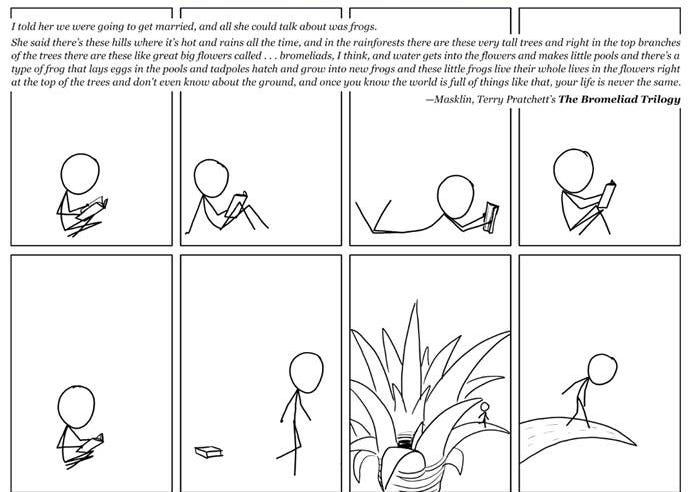
A tribute to Terry Pratchett: “Thank you for teaching us how big our world is by sharing so many of your own.” — Randall Munroe, xkcd #1498, “Terry Pratchett” (CC BY-NC 2.5).